Sovereign Wealth Funds and the USA
A long while back (perhaps 2020 or so) I started suggesting (in private conversation and in blog posts here or there) that America should, as a matter of great national policy and urgency, enforce and bring about the kind of Sovereign Wealth Fund that're all the rage in Denmark and Saudi Arabia (which have been around since the 1990's).
It seems today that some folks have started listening (or independently arrived at the same) and begun advocating these ideas widely in the Press:
- https://www.washingtonpost.com/business/2026/06/18/bernie-sanders-proposes-wealth-fund-give-americans-stake-ai/
- https://www.nytimes.com/2026/06/01/opinion/artificial-intelligence-bernie-sanders.html
The specifics vary and I'd like to take a moment to suss out the key ideas behind my original conception, how it contrasts with the more limited objectives above, and why any of these is likely a great idea for America.
Edit: I was unaware that Trump has also expressed his strong support for Sovereign Wealth Funds as far back as 2025 when I first published this blog post. His approach is Executive-branch centric (as was the apparently tacit exploration by the Biden adminstration mentioned in the Carnegie Endowment article). Two takeaways: as far as I know, Sanders has presented the first Congressional measure and second, support is already more widespread than I originally thought!
Original Conception
It was a bit scant on the details. Generally-speaking, I'm a big fan of endowments (coming from the nearly half-decade I spent working with Non-Profits in Academia in my prior years). Essentially, instead of burning through some budget or payout granted on an arbitrarily determined but consistent schedule (annual budget, fiscal year, etc.), an institution instead raises money (or socks it away) and lets the investments grow. The investments become substantial enough that they can pay for services/goods in perpetuity (on top of the annual budget or what have you). In time, a prudent org can amass such a fortune that they can do outlandish things like go tuition free.
Rough analogies here (for those who like analogies):
- Saving vs. Living Paycheck to Paycheck (but elevated from personal financial circumstances to entirely gigantic national or pan-national institutions)
- South Korean Key Money vs. Monthly Rents
- HSA vs. "Use it or Lose it" FSA that we're often forced to choose from with employment benefits, etc.
Some other similar efforts that should bolster the plausibility of the idea:
- Japan announces $T investment effort - announced a day or two after the original publication of this article - unclear to me if it's a megafund or typical, but massive, Government block grant.
- Alaska Permanent Fund - one of the only Universal Basic Income proto-conceptions operating in America. This is Alaska's state-level oil fund that distributes a small amount of money annually from oil proceeds.
- Federal Intel stake - one-off U.S. Government grant and contract conversion for 10% stake in Intel. Neither a fund nor an ongoing, multi-corporate, operation.
Strangely, before working in Academia (with 501c3's), I hadn't encountered the idea before! We often hear about "the Government [not] saving" but not about the exact means by which it can optimize how it saves or into what. Most of our gotos for personal savings scenarios have no corresponding analogy at the top (for the government itself): 401K, Roth IRA, HYSA, etc. Where should, where, or how does the Government park its money?
Social Security, contingency funds, Pension Plans, Quantitative Easing are basically the only facilities the U.S. Federal Government has available to it and each of these are strictly defined, narrowly scoped to fulfill certain limited operations/services.
Some countries recently pushed far ahead into this analogical metaphor and created huge multi-billion (or trillion)-dollar mega funds (alluded to above). So, despite the absence of such equivalents thus far here at home, it is possible and apparently working quite well over seas for others!
What are the benefits of these kinds of funds:
- It's not just about "saving" - critical social services no longer have to rely on political whimsy, fickle politics, breaking through political gridlock, etc. for funding. If Denmark wants to fund some key initiative (like raising minimum wage) they can just tap into their fund (no business-affecting tax increases needed). (Indeed, we are incessentaly inundated with parroted "taxation" debates here in the USA which just shows how uncreative American pseudo-politics has become - the preference for canned, unmotivating, unctous, and divisive rhetoric instead of offering genuine solvencies. Yes, there are genuine alternatives!)
- Power of the Purse - The Legislature has far more room/expanded ability to negotiate with the various Constitutional institutions/authorities.
- Market Floors - Government can offer something akin to "subsidies" but without the neo-socialist "domineering the commanding heights". A compromise to super-charge small businesses, publicly traded corporations.
- Return on Investment - Debt grows at a predictable rate. Investments grow faster. Pay down the debt and then build up an immense lockbox for the future. New colony on the moon? Pay off all student loan debt ever issued? All things become possible.
- No abrupt suspension of services, payments, or funding.
- Government funding generated from growth, not taxation. At some point, most Government and social spending might be derived from these kinds of vast megafunds. This would be tantamount to a/the holy grail of many political blocs - effective Government but without the taxes. For the first time in history, national economies can sustain that kind of growth (one could probably write a book about this topic alone) and it might entail a kind of virtuous reinvestment that isn't currently commonplace (how many polities have seen businesses up and leave as they try to rectify regional budgets) increasing economic growth overall. This breaks the false dichotomy mentioned before ("to tax or not to tax") as the foundational (and nearly sole) cornerstone of the incumbent political spectrum.
Differences and Details
Going into a bit more detail above:
- Market Floors - some key differences between my original conception and the variant trotted out in the news today is that I believe such an initiative should be voluntary (companies, firms can optionally choose to participate in such a national scheme). Bernie's approach mandates such participation (stemming from his particular brand of political philosophy).
- My original approach suggests that the Government buy up equities in return for certain conditions (profit targets, executive pay ratios, minimum wage and labor statndards being met, etc.) and Sanders believes this should be donated (coerced as the Libertarians might put it - right into the pockets of the Feds). My aim would be to create a neutral, independent, megafund (far eclipsing the staggering wealth of the Fuggers, Di Medici's, Girard's of yore) for the benefit of all Americans to pay down the debt, stabilize budgets, indefinitely fund key services like Social Security/Pensions, raise salaries for Military personel and teachers, etc. whilst supercharging the private sector. Government and Private sector should mutually benefit from the success of each other (this is about close as I get to a committed view of political economy - welfare of the state implies healthy private sector growth and vice-versa).
- That would create the single most powerful financial institution on earth surpassing even the banking system (we're talking equities versus deposits, here). Such an institution could partner will a multitude of large-, small-, medium- sized institutions to facilitate lending, underwrite the insurance industry (itself), etc.
- Hopefully, political fights (debacles presently) in the future would be more productive focusing less on hapless (transient, soon forgotten cultural distractors) and more on actually solving problems with precise financial tooling (and better empowering to create their cultural visions where they see fit - for example, many of the cultural battles throughout exist and are triggered by a near complete absence of institutional alternatives - there's one dominant institution say in sports or in media because there are so few economic opportunities to create alternatives).
- The Federal Government can create such a fund by earmarking a tiny fraction of its annual
$5 Trillionbudget ($250 Billionwould be a good minimum starting point that can be ramped up over time). - Sanders focuses on A.I. but I think the idea should be extended broadly, generally to all industries, but with voluntary or optional opt-in.
- The Trump and Biden Adminstrations are a bit scant on the details (Trump's involving actual documentation and displaying more specificity between the two) and attempt to guide the creation of a Sovereign Wealth Fund through the Execute Branch. (I would prefer a Congressional Act with Executive Branch support.)
- The fund in question must be Federal and substantially meaningful (Tens to Hundreds of Trillions USD) - it cannot be a State, Pension, "stop-gap", "rainy-day", emergency, or contigency fund. Per the above, it can and likely should be qausi-government (an Authority or quasi-governmental corporation like Fannie Mae, Freddy Mac) to preserve the independence, integrity, and nature of its operations.
Charts
So, every substantial public policy article needs a chart or two. I've assembled one. From this helpful document published by the U.S. Senate, the Average Interest Rate of all U.S. Federal debt 3.386%.
The Average Annual DOW return over the last 30 years: 11.80%.
To illustrate how fast America's debt could be outpaced by investing at or around that historic DOW ROI using some Python helpfully suggested by an A.I. (that I had to mostly rewrite - I should probably note that I rarely use A.I. on this site and will usually mention I do so):
import matplotlib.pyplot as plt

def compound_interest(principal, rate, years):
    balances = []
    times = []

    for t in range(years + 1):
        amount = principal * ((1 + rate) ** t)
        balances.append(amount)
        times.append(t)

    return times, balances

def plot_interest_graph(times_a, times_b, series_a, series_b, rate_a, rate_b):
    plt.figure(figsize=(10, 6))

    plt.plot(times_a, series_a, marker='o', color='red', linewidth=2, label=f'Growth at {rate_a*100}%')
    plt.fill_between(times_a, series_a, color='red', alpha=0.4)

    plt.plot(times_b, series_b, marker='o', color='lightgreen', linewidth=2, label=f'Growth at {rate_b*100}%')
    plt.fill_between(times_a, series_b, color='lightgreen', alpha=0.4)

    plt.title('Compound Interest Growth Over Time', fontsize=16, fontweight='bold')
    plt.xlabel('Years', fontsize=10)
    plt.ylabel('Balance ($)', fontsize=10)
    plt.grid(True, linestyle='-', alpha=0.3)
    plt.legend()

    plt.savefig(
        "Compound Interest Comparison.svg",
        format="svg",
        dpi=300,
        bbox_inches="tight")

    plt.show()

starting_amt = 1
years = 50
rate_a = 0.03386
rate_b = 0.1180
times_a, series_a = compound_interest(starting_amt, rate_a, years)
times_b, series_b = compound_interest(starting_amt, rate_b, years)
plot_interest_graph(times_a, times_b, series_a, series_b, rate_a, rate_b)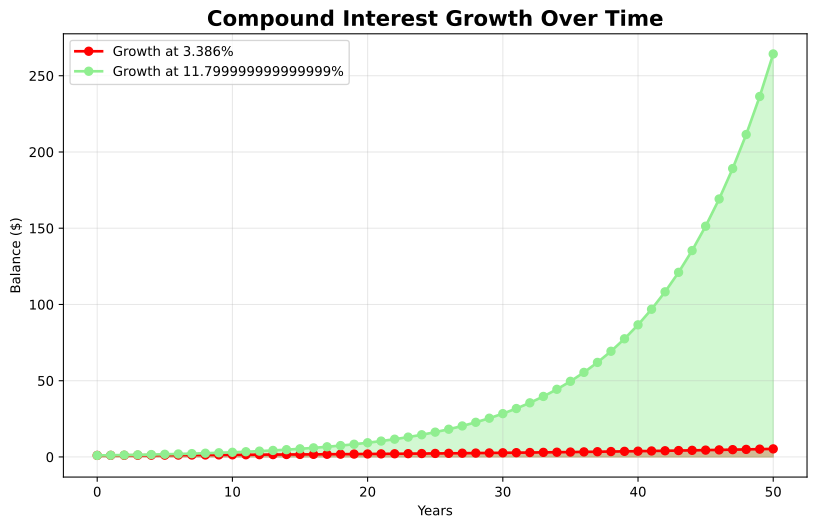
And let's do a second:
import matplotlib.pyplot as plt

def compound_interest(principal, rate, years, annual_contribution):
    balances = []
    times = []
    total_amount = principal

    for t in range(years + 1):
        total_amount = ((total_amount) * (1 + rate)) + annual_contribution
        balances.append(total_amount)
        times.append(t)

    return times, balances

def plot_interest_graph(times_a, times_b, series_a, series_b, rate_a, rate_b):
    plt.figure(figsize=(10, 6))

    plt.plot(times_a, series_a, marker='o', color='red', linewidth=2, label=f'Growth at {rate_a*100}%')
    plt.fill_between(times_a, series_a, color='red', alpha=0.4)

    plt.plot(times_b, series_b, marker='o', color='lightgreen', linewidth=2, label=f'Growth at {rate_b*100}%')
    plt.fill_between(times_a, series_b, color='lightgreen', alpha=0.4)

    plt.title('Megafund Against U.S. National Debt Growth Over Time ', fontsize=16, fontweight='bold')
    plt.xlabel('Years', fontsize=10)
    plt.ylabel('Balance ($)', fontsize=10)
    plt.grid(True, linestyle='-', alpha=0.3)
    plt.legend()

    plt.savefig(
        "Megafund National Debt Comparison.svg",
        format="svg",
        dpi=300,
        bbox_inches="tight")

    plt.show()

years = 50
rate_a = 0.03386
rate_b = 0.1180
times_a, series_a = compound_interest(39_280_000_000_000, rate_a, years, 0)
times_b, series_b = compound_interest(250_000_000_000, rate_b, years, 250_000_000_000)
plot_interest_graph(times_a, times_b, series_a, series_b, rate_a, rate_b)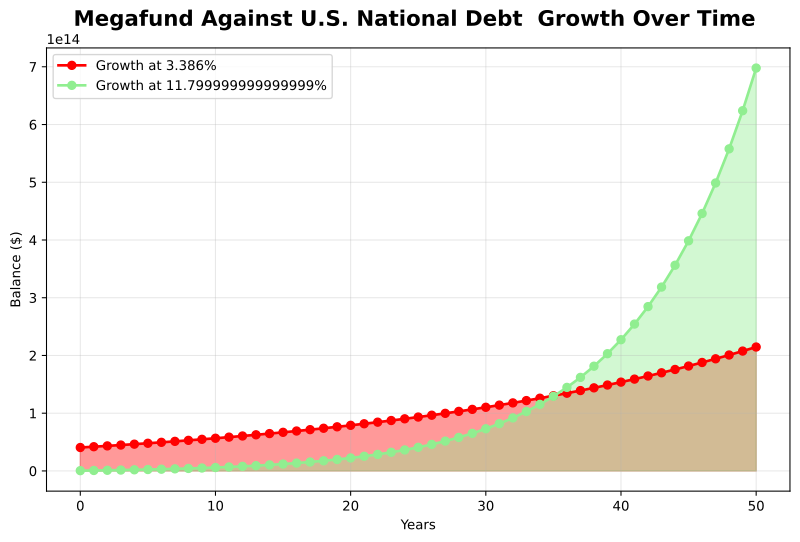
If such a fund were created in the vein of the paradigmatic "Social Security lockbox" (created but saved up for some mandatory period of time before being spent) it'd be able to outpace Federal Outlays and obligations sometime late century or next. That'd ultimately pay off America's debt (serve as collateral otherwise) and can grow (in any outcome/scenario) to be used as policy makers see fit.
Summary
Kudos to Bernie Sanders (and other tech luminaries) for spearheading this kind of discussion (I understand that behind closed doors these topics have been broached before but this is, apparently, the first time its been taken seriously or at least seriously considered in the USA). (And, to be clear I'm not typically a big Bernie fan - not a huge detractor either!)
While I think there are some key details that can/should be hashed out (and isn't there space for the myriad D.C. political factions to take a specific stance within the scope of this idea?), the overall benefits are clear - such megafunds are working for other countries and will help to smooth away the budgetary/fiscal woes of today for America's future generations.
post: 6/18/2026
update: 6/22/2026
update: 6/24/2026
update: 7/9/2026